Testimonies

They Killed My Mother on August 6, 2018. What Followed.

My mother left the house that morning for her daily walk.

She did this every day. She was in her eighties and she moved through the world with the kind of quiet dignity that came from a life well-lived and deeply loved. She was careful. She was healthy. She had plans. She had a trip planned to come visit me and my family just days later. She had just had the house freshly painted, new appliances brought in, and had worked for months to make it perfect for later, when I would spend more time in Morocco. She wanted it ready for me. She wanted it to feel like home.

Mom never came back from that walk.

On August 6, 2018, Pierrette M’Jid, my mother, was struck and killed by a driver in a large SUV while on her morning walk along the Corniche in Casablanca. Every morning, she would walk from the house to that avenue along the ocean, walk alongside it, breathe the air, and then make her way back. It was her ritual. It was her peace. That morning, she never made it home.

By all accounts, the killer drove straight toward her. He did not brake. He did not swerve. There were no brake marks on the road. He struck her head on, then tried to flee the scene. He was caught only because, as he fled, he struck another car and got stuck. The sentence he received was so light, so incongruously mild for a life taken, that it shocked all those who heard it. I, her only daughter, was devastated beyond words.

My mother was killed at approximately 6:30 that morning. Elkabous told me the driver had been drunk and drugged, and that he had no license. Though I no longer believe anything that individual says. What I do know is what the facts established: no attempt to brake, no skid marks, and an attempt to flee the scene.

And I know something else now. Since this blog was published, multiple people have contacted me separately, executives, physicians, journalists, family friends, each telling me, independently, that they believed Elkabous was involved in my mother’s death. Each of them indicated that this belief was widely shared among many in Casablanca. The people reaching out to me did not know each other. They did not coordinate. They each came forward from different places with the same conclusion.

I am not a prosecutor, but I am placing facts in their sequence. I am reporting what I was told and by whom. Others may draw their own conclusions. I have drawn mine.

And what followed tells you everything you need to know about the individual who had been circling my family for years. It was a plan already in motion.

Soufiane Elkabous already in her bedroom, already emptying her safe.

I took the next flight out of New York and landed in Casablanca the very next morning, hours before her funeral, less than twenty-four hours after my mother was killed.

And I discovered that in that same window of time, before I had even landed, before she had even been buried, Elkabous the ungrateful, Elkabous the thief, had already entered her private bedroom, opened her personal safe, and emptied it entirely. The safe she had given me the combination to during her last visit to the United States. The safe where she had placed the inheritance documents, the copy of the clear house title, her will, valuables she intended for me, and the pieces that had survived the prior theft, fragments of a life she had built across sixty years with my father, and plans for life after her departure.

Gone. All of it. Stolen before she was buried.

What kind of animal does that? What cold calculation, what darkness precedes such an act?

In reality, that act did not happen in a vacuum. And nothing about it was spontaneous.

In the months before she died, there had already been a warning, one I described in my previous post, that my mother had shared with her sister, my aunt Colette, and with me, and that had left her genuinely afraid. No one ever answered for what happened to that first safe stolen from a wall. No one was ever asked to.

Then, she did not believe the version of events pushed by Elkabous, that the maid had done it. She did not for a single moment. But the version she believed instead was far more frightening.

My mother expressed fear in the months before her death. Privately, she named a source for that fear. She was killed a few short months later. And the person she feared walked into her bedroom within hours of her death and took everything she had tried to protect for me. Without delay. Without hesitation. As if he had been waiting. Or knew it was coming.

What I also know is this: the driver who killed her faced justice, however inadequate the outcome.

On the other hand, the individual whose criminal behavior was known long before this series of events, whose role in my mother’s death is at the very least an open question, who violated my family’s home on the day my mother was killed, who emptied her safe before she was buried, who plundered her bank accounts after her death, who forged documents in her name after she was gone, who occupies the home she left to me to this day, who stripped it of everything it contained, who erased her name and my father’s name from every registry he could reach, that individual never had to answer for his actions. No consequences. No investigation. No justice. Nothing at all.

He walks freely. He sits behind my father’s desk. He illegally uses my father’s name. He occupies my parents’ home. He has admitted to these crimes, one by one, without remorse, with contempt, with the ease of someone who believes that justice will never reach him.

My mother was not a footnote. She was not collateral damage in someone else’s story. She was Pierrette M’Jid. She was the wife of my father, Mohamed M’Jid, for sixty years, a man who devoted his entire life to Morocco. She was my mother and that of my only and younger brother, Karim, who left us too soon. She loved her life in Casablanca. She loved our home there. She loved her garden. She loved her morning walks along the Corniche. She called me every day. She shared the news with me. She always inquired about my family and followed everything closely. She missed my father every single day and spoke of him with the same love in her eighties as she had at twenty-two, when she met him.

She did not deserve what happened to her. And, she did not deserve to have her death followed by the desecration of everything she had built and protected.

And this will not be forgotten.

The documentation is complete. The facts are on record. The pattern is established. What remains now is justice, and the full and unflinching exposure of everything that was done.

To those who know the truth and have chosen to speak up, to share it, and to act in whatever way they could: thank you. Your courage matters more than you know.

To those in positions to act, who were entrusted to act, who committed to act, and who did nothing: history will record your inaction. Your silence favors the criminal. Everyone knows that much.

But this story will not stay contained to these pages. Its exposure will reach far beyond where it stands today. The injustice demands to be heard, everywhere. And we will not stop telling it.

For Mom.
Testimonies

The Theft in the House

In earlier posts, I set out hard evidence of betrayal, theft, appropriation, and crime. Here, I add something different: context. The world in which my mother lived, the discussions she had with her sister, my aunt Colette, and me before she was killed, and the questions that remain.

The theft inside the house, just months before her death, cannot be separated from those concerns. In the winter of 2017–2018, during what would turn out to be my mother’s final winter, a chilling event unfolded inside my parents’ home in Casablanca.

Upon my mother’s return from France, where she had gone to visit her sister, she discovered that our family’s safe, which had been inside the house, had been stolen.

That safe was very heavy. It was bolted to a wall and hidden behind a private door in the upstairs closet of my mother’s bedroom. Only she and my father used it.

Yet the safe itself had been extracted from the cement wall and taken out of the house. It was gone. In its place was a giant hole in the wall.

Mom was in her eighties then, and Dad had passed away. There was a lifetime of souvenirs and valuables in that safe, none of which could be replaced. Beyond values, these were pieces of memory, moments past, identity, and love.

Within it were some of my parents’ most treasured possessions, both in meaning and value. Gifts from my dad to my mom, gold jewelry, diamond earrings, my father’s own wedding ring, my grandfather’s watch, family paperwork, legal documents, saved money, and much more.

All heartlessly stolen.

My mother was devastated.

Nothing else was stolen from the house. Nothing else was out of place. No lock was broken.

Did the thief know what he was looking for? Did the thief know precisely where to look? Did the thief have access?

It happened while she was away. Did the thief know that, too? 

And dislodging that safe from the wall was not a task for the weak. How strong did one have to be to remove it and to carry it?

And how could someone remove that heavy and large safe from the house without being noticed? Is it possible someone actually drove their car inside the gates to put the safe in it before driving away with it? But who could have done that without standing out?

It did not seem possible without the unthinkable. Someone who would not stand out. My mother was worried. And troubled. And afraid.

Soufiane Elkabous didn’t have so many questions. Without any evidence, he promptly blamed my mother’s long-time maid, Rashida.

Never mind; she was away with her family while Mom was traveling. Never mind that she could not physically remove the safe from the wall or carry it to a car. Never mind that she didn’t know how to drive or have a driver’s license. Never mind that she would have stood up if she had gone into the house in the middle of the night. For Elkabous, all those facts were irrelevant. It was her.

Rashida had started working for my parents part-time when my father was still alive, before switching to full-time employment four years before this event. She had been deeply supportive of my mother as she was reeling from the loss of my father, and she was always present, always attentive. This woman was a single mother with children, including one with challenges. Her oldest son would watch the other kids while she was at work, and she would go home every night, about an hour away, commuting by bus.

She loved both my parents and treated them as her own family. Nothing had ever disappeared from our home. My mother entrusted her with items of value all the time, and she could have easily monetized them without the hard labor required for this operation.

Rashida was the last person my mother suspected and would ever suspect of the theft. The last person I suspected, too.

Despite her growing concerns about Elkabous’ behavior, temper changes, and actions since my father’s death, and his intimidating behavior towards her, my mother rejected his unjustified accusation against Rashida, refused to fire the maid as he demanded, and, in fact, asked her to stay. Despite the humiliation and fear, Rashida remained by her side.

Although it did seem that the betrayal came from within the very walls of her home, she knew it was not Rashida. And, as she did, the picture became darker.

Privately, my mother confided her concerns to my aunt, her sister Colette, and to me. She openly stated that she did not believe the theft had occurred as Elkabous claimed. This crime was executed with precision and insider knowledge. She had her own strong suspicions, grounded in logic and circumstance, which she expressed to my aunt and to me. And they were far more plausible than Elkabous the fraudster’s story. And they were scary. Could it be? Mom believed so.

At the time, Mom didn’t think it could get worse. Sadly, she was wrong. The theft of the safe didn’t turn out to be an isolated incident. It proved to be part of a sequence of events that would lead to her death, and, beyond her death, to property theft, identity theft, bank theft, and more.

At my mother’s funeral, Rashida came to my parents’ house to pay her respects. The thief promptly forced her out in front of neighbors and friends, creating a scene that left those present dismayed but impressed enough to recall it to this day, and too intimidated to intervene.

Rashida still came to the cemetery. I saw her hiding by a tree, just a few steps from my aunt and me. She was crying and praying. I thanked her. We hugged. We kissed. She paid her respects, in private. Rashida was not the one responsible for the theft.

Testimonies

A Summary Before We Continue

I have received many messages of support since the beginning of this blog, in addition to my aunt’s, almost all accompanied by a request for anonymity, most often explained as fear for their safety or that of their family. Some have even promised to take action, only to disappear, like others before them.

But, although it may seem riskier to confront this evil for those who live in Morocco, isn’t it even more critical for them to fight this battle together, lest today’s silence condemns everyone’s tomorrows?

Since launching this blog in July, I have documented a clear pattern of criminal behavior. Let me summarize what has been established:

The Foundation:

  • Soufiane Elkabous seized a foundation created to help others and used it for his personal needs.
  • He stole my father’s name and used it to create a false image of legitimacy.
  • He pretended he was related.

The Safe and Documents:

  • He broke into my mother’s private safe, in her bedroom, on the day of her death. Before she was even buried.
  • He stole everything inside.
  • He forged documents, inventing debts for my parents years after their death.
  • He filed the forged documents in national registries, thus corrupting the very integrity of those registries.

The House:

  • He occupies the home my parents left me, a house that is not his, without right or title.
  • He stripped the house of all my parents’ belongings, everything it contained.

The Bank Accounts:

  • He plundered my mother’s bank accounts at the BMCI Val D’Anfa branch after her death, without any authorization. 

Identity theft. Burglary. Theft. Forgery and uttering. Illegal occupation. Inheritance spoliation. Embezzlement. Breach of trust. 

These facts are established. Documented. Admitted by Elkabous himself. Together, they reveal a pattern of criminal behavior spanning years. He does not even bother denying them. In fact, he boasts about them. The law does not apply to him.

Still, no consequences. Still, no investigation.

Still, I will keep going.

And there is more. Next, I will share an event that occurred before my mother’s death, the winter before she was killed, an experience she discussed with my aunt and me, concerns she shared, fears she expressed, and what she believed about it.

The pattern did not begin in August 2018. It began much earlier.

And Mom knew it.

Testimonies

From Colette, sister of Pierrette M’Jid

I want to pay tribute to my aunt Colette, my mother’s beloved sister, for choosing to share this testimony. Tati Colette, as my brother Karim and I used to call her, has always remained close to my parents and to me, in moments of happiness as well as in times of hardship.

She was by Mom’s side and with her at Dad’s bedside when he was hospitalized in Bordeaux or in Rabat. She is still at our side, facing this injustice today.

“We left Morocco at the end of 1977 after eighteen years spent in that beautiful country. At that time, Soufiane Elkabous was still just a child, far from what he would later become.

Later, as an adolescent in total academic failure, he rejected the education that my brother-in-law, M’Jid, and my sister, Pierrette, tried to give him.

When we saw him again in Morocco fifteen years later, he had become an adult, physically imposing, already temperamental, unmanageable, authoritarian, and aggressive. And in the many times we crossed paths with him afterward, he only confirmed this image.

After serving in the gendarmerie, from which he was eventually dismissed for questionable behavior, he had already become the owner of several apartments, luxury cars, and had ready cash at his disposal. On a gendarme’s salary!

Away from the M’Jid family, he even bragged about regularly paying colleagues to replace him at his gendarme post during his shift, ordering them to ‘turn their backs’ when suspicious shipments were announced to him.

After that, his assets multiplied very quickly: La Notte, a farm, a beauty salon, studios rented out by the half-day, and, of course, always more cash. Who can accumulate so many assets without really working? We never got an answer.

Little by little, his ties with the M’Jid family weakened. Contacts became rarer. He lived his shady life away from us. The M’Jid family, asking themselves questions, were afraid to understand. M’Jid himself, out of dismay, had even asked him to be less present and not to flaunt his luxury cars in front of the family home.

One day, my sister told him someone had bothered her during her morning walk, and he went out of the house and beat up the first poor man he came across in the street, even though he knew he was not the culprit! This innocent man was severely injured. One hundred and fifty kilos against fifty… such ‘bravery’!

He had become, and he has remained, brutal, closed to dialogue, rejecting reasonable discussion and never tolerating dissent. Surrounded by cowardly, self-interested sycophants, on their knees and at his service, he frightens his employees, whom he treats like slaves.

After M’Jid’s death, my sister came to our home in France more often. During her stays with us, we clearly observed that she would go two or three weeks without any contact with him. Their relationship was deeply strained. We were relieved, because he was hurting my sister and had never deserved the affection that the whole M’Jid family had given him.

Ungrateful, he knew only how to impose himself through uncontrolled violence.

After the death of my dear brother-in-law and sister, the parents of my niece Asma, he decided, through clearly fraudulent maneuvers, to rob her of everything. He moved into the family home, and he emptied my sister’s bank account.

Asma cannot even safely travel to Morocco to recover her inheritance, as she is directly threatened by Elkabous and his mafia network, which he pays to execute his orders outside of the law.

I myself underwent a humiliating and threatening check at Casablanca airport by one of his men, who clearly told me he wanted to prevent me from leaving after my brother-in-law’s funeral.

May all those who knew and loved her parents give their support to Asma. She cannot fight this battle alone. She needs each and every one of you. Thank you.

It comes from the heart.”

— Colette

It should no longer be necessary to bring further testimony about the criminal Elkabous after all I and others have already revealed. His actions speak for themselves, so long as one does not decide to ignore them. Yet, it seemed important to me to make an exception here and share the perspective of a family member who knew him from the beginning with us all the way to what he has become today, a blight on society.  Asma

Testimonies

Exposed, He Quietly Changed His Name on the Foundation Site

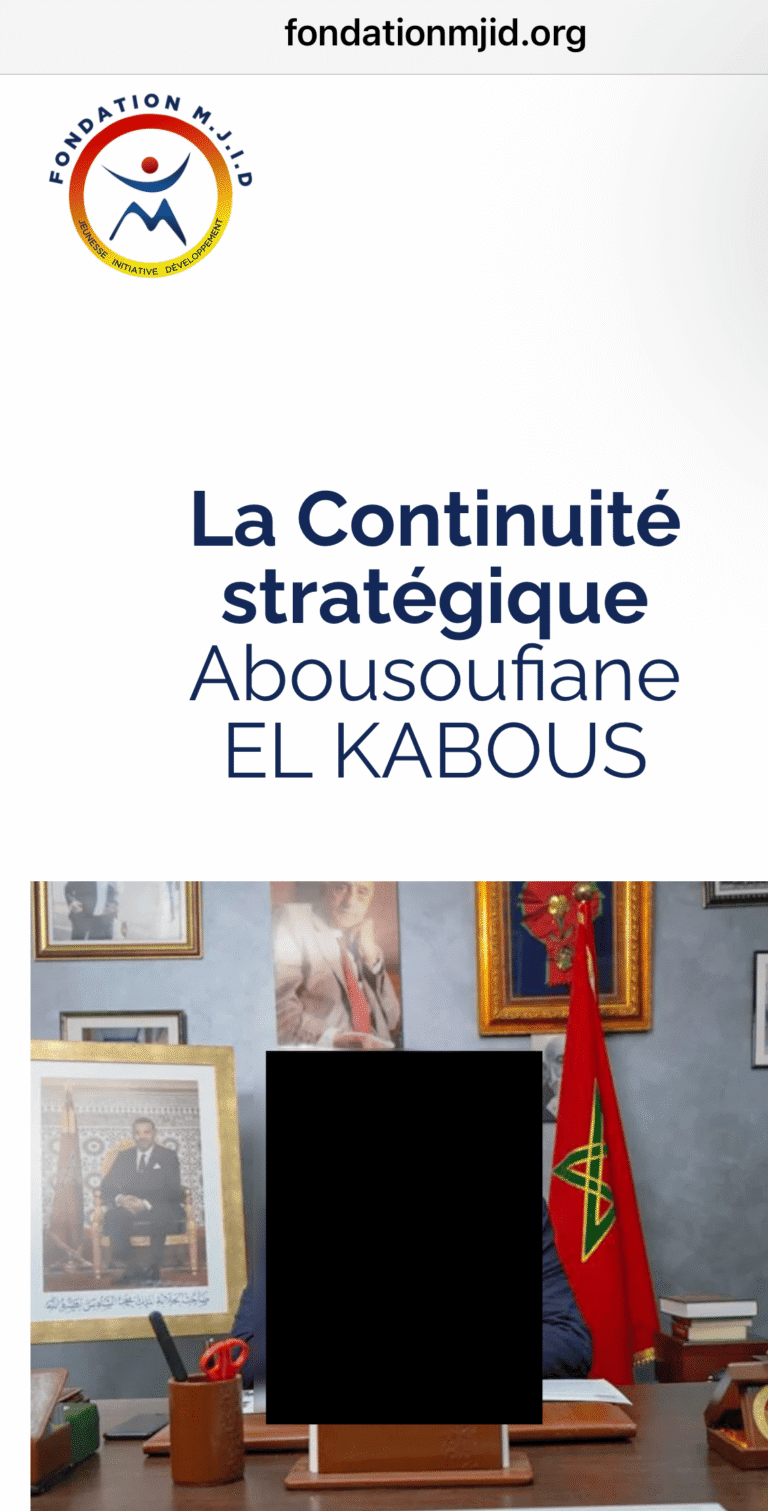
After exposing how Soufiane Elkabous illegally appropriated the M’Jid name and turned the MJID Foundation from a public-serving institution into a tool for self-promotion, a quiet change appeared quietly, behind the scenes, on the foundation’s website.

For years, the usurper displayed the fake name “Soufiane Elkabous M’Jid” on the foundation’s website, placing it directly beneath my father’s name, deliberately creating and sustaining the false illusion that he was the natural heir. I made it clear in the same article: Elkabous has no legal ties and no blood ties to my father, to my family, or to our name.

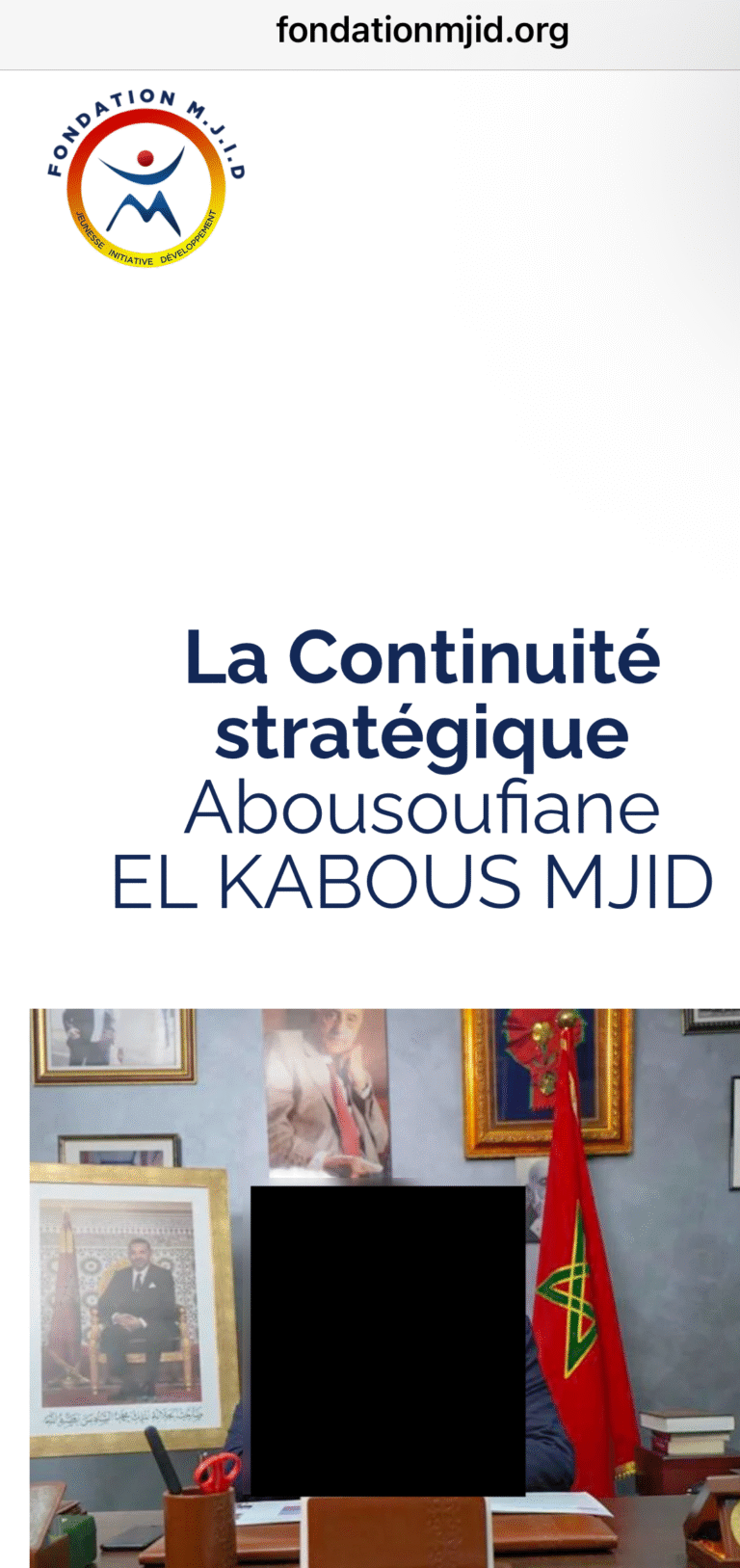
By Sunday, August 17, 2025, the usurper finally had the name “M’Jid” removed from his surname on the foundation’s site. His name now reflects his legal identity, as it always should have: Abousoufiane Elkabous.

Not M’Jid.

It took public exposure to force him, in shame, to stop stealing my family’s name. 

But erasing the name doesn’t cleanse the past, or the intent. On the contrary, it shows he always knew exactly what he was doing, manipulating the foundation’s image. It confirms yet again how Elkabous and his circle shamelessly falsify information to serve their corrupt interests.

He also added a small section about Mr. Berrada, presented as president from 2014 to 2018, to suggest a separation between my father’s death and his own takeover. But why was that name removed in the first place, if not to fabricate a direct link between my father and himself? The answer is obvious. In truth, the foundation’s social media was already flooded with promotions centered on Elkabous: his face, his appearances, his false name, everywhere.

In 2018, the year my mother was killed, Elkabous seized the last remaining powers and made his takeover official. That same year, my father’s final close collaborators left the foundation.

Now that Elkabous has finally removed the false name he gave himself on the foundation’s website, will he contact the donors he deliberately misled to tell them the truth and apologize for this willful deception?

Sunlight is indeed the best disinfectant.

For Dad.

This change is documented below. The first capture is the foundation’s website as it appeared for years, listing Elkabous under the false name “Soufiane Elkabous M’Jid.” The second capture is the corrected version, dated August 17, 2025, showing the removal of the fake name and the appearance of his precise identity: Abousoufiane Elkabous.

Soufiane ElKabous Fake Name

Foundation website showing “Soufiane Elkabous M’Jid” as displayed for years

Foundation website after August 17, 2025, showing removal of the fake name

Scroll to Top